
If you’ve read articles about personal finance, you’ve probably heard of an emergency fund. In fact, emergency funds are one of the most important aspects of personal finance.
Every individual should have an emergency fund.
You don’t have to be working, you can still be a student, college graduate or otherwise, you should always have an emergency fund.
Do you know why?
You’ll probably never know when the rainy days come. Emergency funds should be your first choice to liquidate and exit the situation smoothly, not your investments. Don’t touch them, let them continue to grow 🙂
Once your emergency funds are completely used up and you still need funds to run the show, you can probably think about tapping into other investments or savings. Again, emergency funds are only for “emergency” purposes, not for your everyday iPhone/iPad purchases!
That said, there are some questions and confusion around emergency funds. This is one of the only reasons I wanted to create this ultimate guide to answer all these common questions and clear up any confusion you may have about emergency funds. Now then Iand let’s get started and start saving in an emergency fund soon!
What is an emergency fund?
An emergency fund is an account for funds set aside in the event of a personal financial dilemma, such as the loss of a job, a debilitating illness, or a major repair to your home.
Here are the two main advantages:
1. Peace of mind – Imagine having $2,000 stashed somewhere in case of an emergency. Wouldn’t you feel much more comfortable knowing that if life poops you, you’re at least wearing a diaper on your head?
2. Money saved – Having an emergency fund can save you a lot of money. How? Because you won’t have to borrow money or pay interest to deal with emergencies. You will already have the money on hand.
What are emergency funds used for?
As I said above, emergency funds are strictly for emergencies.
But what is an emergency?
An emergency is something urgent and unexpected that requires money to resolve.
This includes things like:
Emergency funds are not intended for:
What’s not easy is committing to using your emergency fund only for emergencies. It will be very tempting to use this large sum of money for something else.
However, if you take out a little money here and there for things that aren’t emergencies, you’re creating a bad habit that could cause problems in the future if an emergency ever arises.
That’s why you need a better place to keep your emergency fund so that it’s not as easy to spend.
The 3 main benefits of having an emergency fund
1. It helps reduce your stress levels
It’s no surprise that when life presents an emergency, it threatens your financial well-being and causes stress. If you live without a safety net, you are living on the “financial” edge and hoping to get out without ending up in a crisis.
Being prepared with an emergency fund gives you the confidence that you can handle all of life’s unexpected events without adding financial worries to your list.
2. It saves you from spending on a whim
You’ve heard the saying “out of sight, out of mind.” This is the best way to store your emergency money. If cash is as far away as your nearest debit card, you might be tempted to use it on something frivolous like a designer cocktail dress or a big-screen TV, which isn’t really an emergency.
Keeping money out of your immediate reach means you can’t spend it on a whim, no matter how much you want to.
And by putting it in a separate account, you’ll know exactly how much you have and how much you may still need to save.
3. It prevents you from making bad financial decisions
There may be other ways to quickly access cash, such as borrowing, but at what cost? Interest, fees, and penalties are just some of the drawbacks.

Where to keep an emergency fund?
One of the most frequently asked questions is where to place an emergency fund.
The answer is quite simple:
The key to stocking an emergency fund is making sure the money is easy to access, but not too easy.
For example, I wouldn’t recommend keeping your emergency fund in your main bank account. You could mix it with your regular savings or spend it accidentally.
Instead, I recommend keeping your emergency fund in a separate high-interest online savings account.
Wealthsimple offers good online savings accounts with an interest rate of 1.95%.
Should I pay off my debt before building an emergency fund?
If you have credit card debt with an interest rate of 14-20%, you already have an emergency on your hands. This means that you should focus all your efforts on paying off that credit card debt as quickly as possible.
Once it’s exhausted, you can start building your emergency fund.
If you have debt other than credit card debt, you should build an emergency fund of $500 to $1,000 while you pay off your debt. This will cover all basic emergencies and help you avoid going into credit card debt.
Something is better than nothing
Don’t think you can save enough? Don’t panic. You can do this by regularly setting aside small amounts, such as every week or every paycheck. If you continue like this, over time you will eventually achieve your goal.
The important thing is that you have started saving something.
For example, let’s say you set aside $25 per week in an emergency fund. After 2 years, you could have saved $2,600. Increase this amount to $50 per week and your savings could reach $5,200. Earn $75 per week and you’ll see an even bigger amount saved: $7,800.
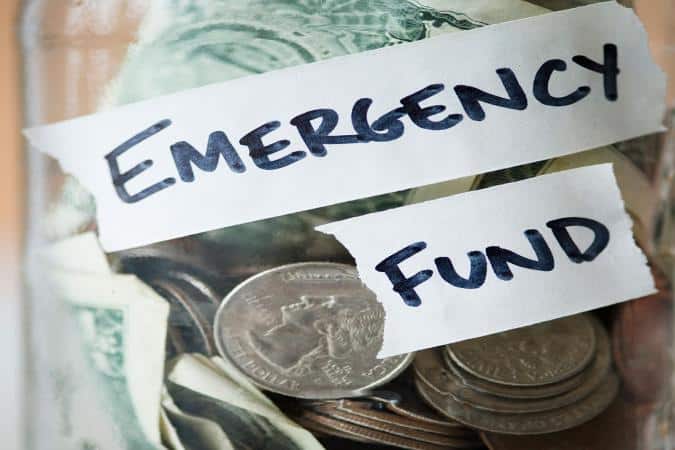
How much money should you have in your emergency fund?
The amount you’ll want to save in your emergency fund will vary depending on your situation, but here are the steps I would take if I was just starting to build my emergency fund:
-
Build a $500 emergency fund. You can do this quickly by selling items around the house or doing other things to earn extra money.
-
Build it up to $1,000. All you have to do is repeat what you did in step 1.
-
Covers 3 months of living expenses. To find this number, simply multiply your monthly expenses by three. If you don’t know your average. monthly expenses, you should learn how to budget.
The reason I recommend these three steps is because each time you take a step, you will get a little boost of motivation that will help you. take the next step. It’s about starting small and working your way up.
Once you’ve completed step 3, it’s up to you whether you want to continue building your emergency fund or leave it as is. Some people will need to cover 6 or 12 months of living expenses, while others may be able to get by with just 3 months of coverage.
The size of your emergency fund will depend on your situation
For example, a freelancer with irregular income may want to save more in their emergency fund because they may not know when their next paycheck will arrive.
The 7 Best Ways to Build an Emergency Fund
There are many different ways to build your emergency fund, but ultimately it all comes down to money.. You either need to earn more, save more, or both.
Here are some great ways to save money for an emergency fund:
-
Save $10 every week. At the end of the year, you will have $520 in your emergency fund.
-
Take a percentage of your salary. Start with 5% and increase it as you feel more comfortable. If you do this with every paycheck, you should be able to build up your emergency fund fairly quickly.
-
Save your tax refund. If you get a tax refund, put it directly into your emergency fund for a quick boost. You only get one chance per year for this one, so don’t waste it.
-
Use an automatic money-saving app. This shouldn’t be your only source of savings, but it is a good savings supplement. If you’re from Canada, you can use Mylo to invest your spare change.
-
Cut expenses. Assuming you have a budget (learn how to create one), you should look at your spending and see if you can make cuts.
-
Save change (spare money) – Mylo does this for you, but you can also save any spare change you receive during the year (think $5 bills, etc.) and put it straight into your emergency fund.
-
Earn Extra Money (Secondary Income) – This is one of the best ways to quickly build your emergency fund. Check out these 20 ways to make extra money on the side.
Last words
Hopefully you now have a better understanding of emergency funds and why they are such an important part of your personal finances.
Remember, your emergency fund will be something you constantly need to work on. If you face an emergency and withdraw money from your emergency fund, you will need to work on rebuilding it as soon as possible.
If you enjoyed the content here, share it on social media and help spread the word. Also, please let me know your questions, thoughts and comments below.
